09 July 2010

The Big Adventure - Part 9

And so to the highlight of our trip: the sand dunes of Erg Chebbi. After breakfast we left our luggage at the hotel and set off towards the dunes, which where visible in the distance from our hotel, looking for a place away from the various hotels in the area. Distance can be deceptive, and the dunes were a few miles away but it was pleasant ride across the gravelly nothingness.


It's easy to understand why people go to see the dunes because they're just what many people think the desert is like – golden, shifting sands like in the Fry's Turkish Delight TV advert.
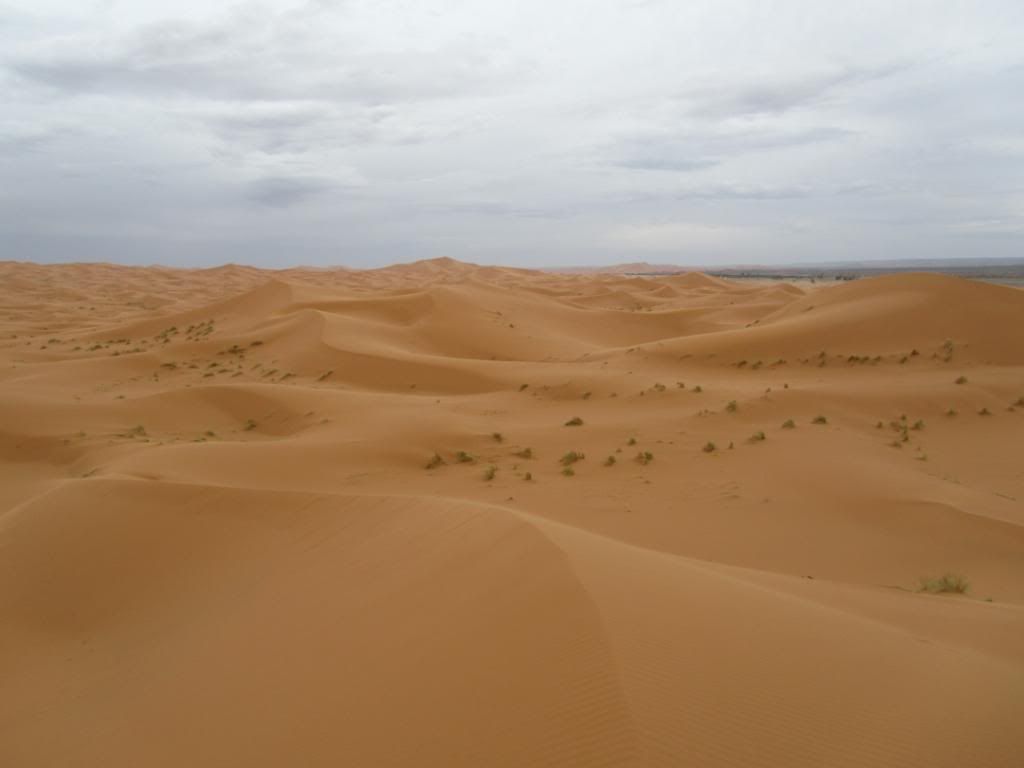
Photo by Gareth Jones

Taking 200Kg of bike, even unladen, in to soft sand isn't for the faint-hearted and it wasn't long before the sand claimed its first victim of many. We were a bit surprised when a young lad appeared and began setting out a display of fossils and the like in the apparent hope that we might buy something from him – the entrepreneurial approach was at least optimistic, but we didn't really have any interest in them and didn't buy anything. But to be fair, we didn't get any hassle from him either.

Gareth was determined to get further in to the dunes, and between us we managed to get his bike over the first dune and in to the valley beyond.

Photo by Mark Littlewood

Mark H and I got stuck a few more times, Jason had a play and Mark L stayed on solid ground.

Photo by Mark Littlewood


Before too long the appeal of the dunes started to fade, and the realisation that perhaps the big Adventures weren't the ideal tool for the job. So we set off back to the hotel with the intention of doing as little as possible, but not before Gareth had decided to walk to the highest dune we could see, and investigate a camel on the way.

The hotel didn't serve lunch, so we set-to with our camping stoves and used some of our own supplies on the patio behind our room. We also took the opportunity to do some laundry, the various luggage straps making an impromptu washing line.


It was a very humid day, much like a British summer day but a lot hotter, so we retired to the pool for a swim, and for some quality lazy time: reading, dozing and listening to iPods. The water in the pool was cold, but once you were in it was very refreshing. I'm not a keen swimmer, but even I did a good few lengths. We'd watched the hotel staff cleaning the pool that morning, and the long grass behind it being cut by a group of ladies, by hand. It looked like they were taking the grass away with them, although what they would do with it we don't know. There were being provided with the traditional silver pot of tea though.


That evening we again gathered for pre-dinner drinks before taking our place in the open-air dining room. The wind had got up, it was a warm wind and thankfully it got rid of the worst of the flies. For most of the trip we didn't have any real problem with flies, mosquitoes etc., but for some reason there were dozens of them around the hotel. In our room we had the air conditioning on and this seemed to put them off, but they were everywhere when we were out and about.

On the menu that night was a dish of chicken and potatoes, and it was obviously the chef's night off because it was the poor relation of the previous night's delicious tagine. Even the desserts were sub-standard with the cheeseboard being particularly meagre after the generous portions of the night before – or perhaps they knew they didn't need to impress us because we were leaving anyway?

In many ways this was the end of our tour – we were turning for home, we were retracing our steps and nothing would be particularly “new” any more. With a slightly gloomy air we turned in for the night.

Next morning we loaded up the bikes and set off towards the Todra Gorge, which runs pretty much parallel to the Dades Gorge. Leaving the hotel I was at the back of the ride and spotted a mini tornado not far from the road. If you look closely you can see the column of dust:


We were riding up the N13, which runs most of the way down Morocco from north to south, traffic was light and the surface was pretty good. Turning off the N13 to head west we again were crossing a lot of nothing, but there were a variety of lay-bys and other places for tourists to stop to have a closer look.

Spotting a handy group (herd?) of camels we set off on foot to take photos (the novelty of camels never did wear off).


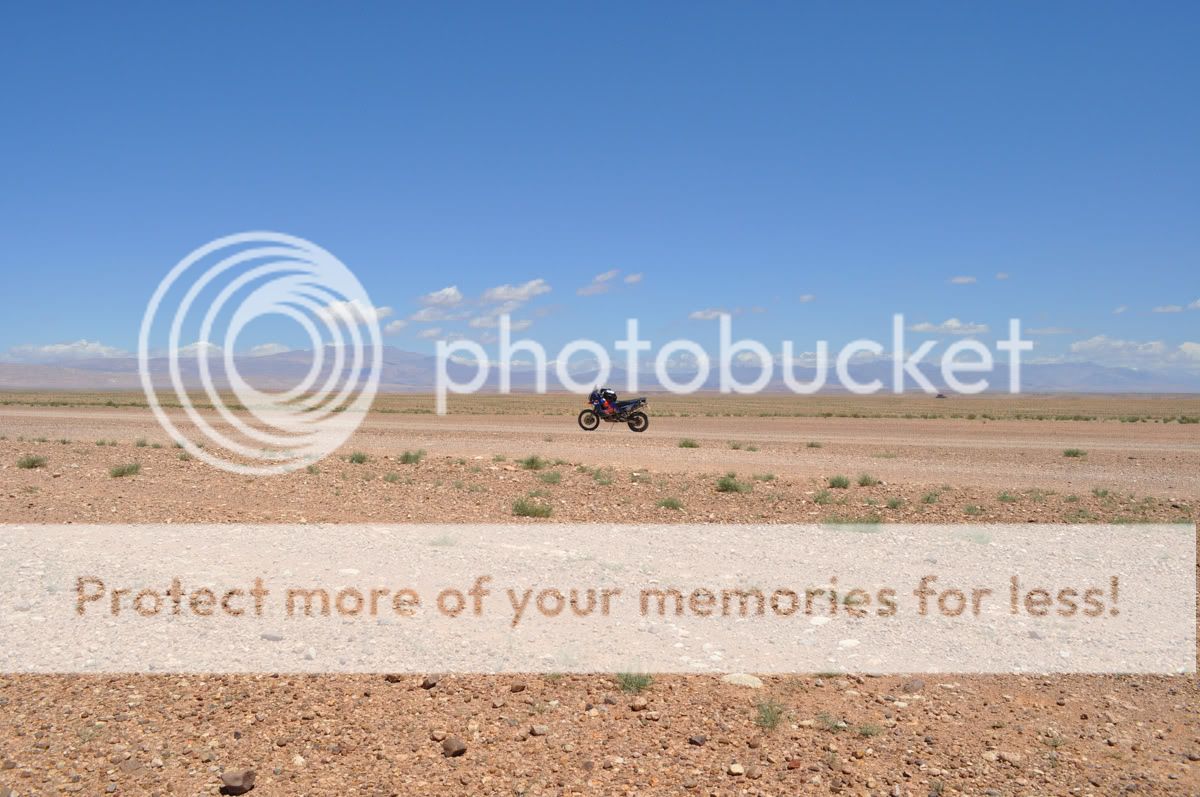
Looking back towards the bikes, despite being parked on a well surfaced road they looked a bit lost in all the open space:


The Todra Gorge is closer to civilisation and consequently was even busier than the Dades had been. Lots of tourists, touts, stalls selling souvenirs, 4x4s and the like. The road was in the process of being rebuilt having been washed away, and there's film footage on YouTube (see below) that shows an intrepid biker riding through the flowing water in 2009. It was nicely shaded though, and a pleasant enough place to have a break.


We'd been given details of a campsite further up the gorge, and the plan was to camp there overnight. Unfortunately, as usual, we couldn't find the actual place so we improvised. On the way up the gorge we'd stopped by somewhere that might or might not have been the campsite, and were immediately besieged by kids wanting sweets, Dirham etc., and wanting us to stay there. Their clamouring was so persistent that none of us felt inclined to stick around any longer than necessary.


We carried on up the gorge, looking for somewhere suitable to pitch our tents. This isn’t an easy task in such a rocky area, but at last we spotted a suitable site on the side of a dried-up river bed. It was still quite visible from the road, but from there we could see a more secluded spot a little further up the riverbed that was out of site of the road. The ground was soft and reasonably flat, so we decided to stay.

Photo by Mark Littlewood

With the tents up and the stoves on the go heating water we were pretty comfortable; and it was a lot cooler than it had been in the desert! As I’ve said before, you’re never alone in Morocco, and it wasn’t long before we had a visit from a young shepherd. He stood and looked at us for a few minutes, then disappeared again.

Dinner was prepared from our long-life, boil-in-the-bag meals (beef stew with dumplings for me), and we enjoyed the last of the evening sun by exploring further up the river before watching another beautiful sunset.


Next morning we were woken by the sound of cowbells and the bleating of sheep as the shepherd from the previous evening drove his flock straight through the camp. It was a bit of a rude awakening, but no harm done.

Photo by Gareth Jones

After breakfast we packed up and returned to the road. The road up from the Todra Gorge had been recently surfaced, was deserted and had some spectacular views.


I can also offer a ‘tip-of-the-day’ at this point: make sure your pannier lid is closed before riding away – especially if it’s the one with all your paperwork in it. Fortunately nothing fell out, but I did feel a bit of an idiot!

The road wound up in to the mountains, and on one corner with a particularly impressive view we encountered a pair of British riders who were heading south on smaller trail bikes: one on a Honda the other a Suzuki. We chatted with them for a while, exchanging trail-notes before setting off in opposite directions, their adventure still to come.


We’d decided that rather than extend our journey home for the sake of it, we’d get on and head back to Spain a couple of days early to allow some rest and relaxation before flying home (ash cloud not withstanding). Our destination was Midelt, and the same hotel we’d stayed at on the way out, and where Gareth and I caught up with the others two week previous.

Our route took us back to Imilchil, and through the town of El Rich [El Reesh]. The roads through the mountain wound along the valleys with flowing bends that were great to ride, with the odd village and junction to break it up.

On the edge of Imilchil there was a small group of children waiting at a road junction. They did the usual scrounging for sweets, Dirham etc. from us, but by this stage we didn’t have much left. I was at the back of the ride, and one young chap got a little too close and was caught by my pannier as I pulled away. I only know this because in the mirror I saw someone doubled over at the side of the road, put two-and-two together and assume it was the chap who been tapping me on the leg while I’d been stopped. Perhaps he’ll stand a bit further back from bikes next time…

Lunch was due to be in El Rich, but after being mobbed at the petrol station on the outskirts (to the point where the staff at the filling station were chasing the kids away), and not seeing anywhere all that appealing in the town itself we decided to press on.


Instead we stopped on the edge of Midelt and watched a chap on a locally registered Yamaha R1 ride backwards and forwards. Posing bikers on sports-bikes are the same the world over – except for the lack of race rep. leathers, which would be far too hot.

In the centre of Midelt they were rebuilding a bridge across the river, so there was a diversionary route signposted – although Mark L who was leading had other ideas and we plunged in to a maze of narrow residential streets. Encountering a a small square with several roads leading in different directions, and with no sign of Mark ahead, we could only guess which way he’d gone, and fortunately we got it right. Quite what the residents must have made of us, I don’t know!

Arriving at the bridge, the only option was to ride across the parallel footbridge, which was wide enough (just) for a fully laden Adventure. We were split up by oncoming pedestrians, and someone on a moped who’d had the same idea as us, so when we got to the other side (cue joke about why did the biker cross the bridge…!) the advance party was nowhere to be seen. Recognising where we were from the outward journey, close to the start of the Cirque du Jaffar, we set off in hot pursuit and caught them up.

Arriving in the familiar courtyard of Kazar Timney, we were soon making ourselves comfortable in the same rooms we’d had before. But there was a surprise in store: after the disruption of the dust cloud and talk of riding back to the UK, Mark H decided that was what he was going to do – ride up through Spain and France, and get the ferry back to the UK. The last we saw of him was the back of his bike disappearing in a cloud of dust, in a northerly direction.

Dinner that night was our last tagine of the trip, chicken and lemon, and a few drinks. It was much warmer than it had been on our previous visit, and we were grateful for the air conditioning in the room. We also played with the satellite TV in the room, but could only find what might be euphemistically termed adult channels – which was certainly a surprise in a Muslim country (or perhaps it was to cater for the western audience?).

In the other room, the electrics were keeping us entertained where one switch turned on the light, another made it flicker, and a third reversed the whole lot while turning on the bathroom light. I suppose that Joseph Lucas, AKA The Prince of Darkness, needed to do something after he retired from the automotive industry.

Outside I got talking a Danish couple who were staying in their caravan. Their two sons race KTM bikes in Denmark, and he was interested in our big KTMs, where we’d taken them and how we’d got on with them.

Tomorrow’s plan was to get to the hotel in Chefchaouen that they’d stayed in while Gareth and I were stuck in Spain. The route took us through Meknes, and it was absolute chaos. Roadworks were in progress on the main four-lane road through it, so the traffic just crossed the central reservation and used both sides of the road. Police officers were blowing whistles and waving their arms, and nobody was taking any notice. With the traffic being as heavy as it was, filtering wasn’t an option but eventually we made it though almost unscathed: somehow Gareth managed to collide with a wheelbarrow, adding some fresh dents to his pannier and getting a very dark look from the workers.

We also decided it was time to do some souvenir shopping, so we made a couple of stops to look at various pretty stones, fossils, tagines and other trinkets. Mark L and Gareth decided to take home a tagine (dish) each, which lead to the challenge of fitting them securely on to their bikes:

"Is that a tagine in your pocket, or shall we do a very old joke?"

I opted for miniature versions that had been carved out of stone, and a small ceramic one that might be just about big enough to do a couple of olives in. We rode past the Danish couple on one of the steeper hills, and they stopped for another brief chat when we’d pulled in to look at some stalls in a lay-by.

At one point we had to pull over when Gareth got stung by a wasp, and a group of children came over to see us and scrounge sweets etc. They also found the throttle on my bike, and I was able to divert their attention from begging to revving. Another motorist, heading in the opposite direction, stopped to remonstrate with them – I don’t know if it was because they were “pestering” us, or whether he knew them or something else, but the kids ran off as soon as he got out of his car.

Arriving at the hotel on the edge of Chefchaouen, it was busy with people watching a football match on a large TV in the non-alcoholic “bar”. It was the most formal hotel we’d stayed in, with passports required at check-in, and the rooms were small but comfortable (although the light in the shower didn’t work in the room Jason and I shared). We sat down with a drink (coffee or Cola) and watched the game, and apart from the absence of alcohol we could have been in a sports bar almost anywhere.

Photo by Mark Littlewood

Unfortunately that's where the good bits ended. The hotel didn’t serve food, either an evening meal or breakfast, there was one gents toilet for all the rooms, and it was broken, a pack of dogs across the road from hotel were barking all night and kept us awake all night – so none of us were at our best the following morning for the last push to the border at Sebta.

It felt a very long way, but it was only a couple of hours to the border and we arrived about 10.00 to begin the process of leaving Morocco and exporting our bikes. Thanks to a text message from Mark H the previous evening, we knew pretty much what we had to do, and we took it in turns to go to the window to get our exit stamps and to hand in another section of our D16 vehicle forms. We’d also intended to change our remaining Dirham in to Euro, but as it was a Sunday the exchange offices appeared to be closed.

In the confusion of vehicles and people, the other three managed to get ahead, and by the time I got back to my bike to go to the frontier proper, they were already en route to Spain. Crossing back in the EU was just like any other EU crossing when you’re an EU resident – they didn’t even glance at our passports and just waved us straight through.

Owing to the time difference, it was now Noon, and Gareth and I needed to get ferry tickets for the same company at Jason and Mark L. There are plenty of shops offering tickets for all three companies, and we found one just near the port and duly bought tickets for the next Baleària crossing at 14.15. Mark L, forgetting the time difference, wondered what we could do in Ceuta for four hours, when it was only going to be two – and with check-in time it was really only an hour and a half!

Having not eaten since lunch the previous day, we spotted a drive-through McDonalds and decided that was probably the simplest option. Great in theory, but although it had a drive-through it didn’t have a car park… We eventually found a spot to park (well, it was more abandon than park) by the aquarium just a short walk away, and we duly tucked in to Spanish chicken burgers, chips and Coke while watch the world, and the incoming Malaga to Ceuta helicopter, pass by.

Despite it being a domestic ferry to Algeciras, security was pretty tight at the port, with passport checks and a sniffer dog watching the passing traffic. The security is almost certainly to prevent illegal immigrants who’ve managed to sneak in to the Spanish enclave from getting an easy passage to Europe.

The boat was a much more modern then the one Gareth and I had been on when going the other way, and was a mono-hull fast ferry instead of a catamaran. Taking the travelator up from the car deck I headed for the lounge with leather seats and a sea view – but the others had a different idea and headed to the café.
Photo by Mark Littlewood

When we arrived in Algeciras we’d made a rough plan to find a camp-site for the next two nights before our flight home (we’d still no idea whether it was cancelled or not). Our destination was Ronda, which I thought was in Wales but isn’t (well there’s a Rhonda in Wales), and we set off from the port on to the Autovia. Through a combination of heavy traffic and reduced speed limits we got split up, only to see the other three disappear down a slip-road as I was in the middle lane… Bother.

Still, we got back on track and took the road up in to the mountains. I can see why the area is popular with bikers for the roads were very twisty, generally well surfaced, and fairly quiet. We found a camp site on the edge of Ronda that seemed very upmarket, with a swimming pool, lots of grassy pitches and lots of rules – including no groups! Undeterred, we went in to reception and they were happy to show us the various options. They had a number of self-catering chalets available, with twin-beds and en-suite facilities for the reasonable sum of 60€ per chalet – so we took two. I was very relieved that we wouldn’t be in a tent again and looked forward to a good sleep.


The café was very busy with people enjoying the last of their weekend, and we joined them drinking a cold beer or two in the evening sun. There was also food available, and by this time we couldn’t really be bothered to go anywhere else, so we tucked in to a reasonably tasty, if slightly pricey, meal.

With nothing planned for the next day, I decided to head back over to Redtread Honda in Cómpeta to say hello, thank them for their help and let them know how we’d got on. It’s easy to forget relative distances, and it was a little over two hours later that I arrived in Cómpeta but not before having a slightly unnerving moment when I spotted the Police speed-check just as I was passing a slow moving van. I was definitely over the speed limit, but the officers just waved me on my way – phew!

That evening was pretty much a repeat of Sunday evening, with more beers on the terrace, and a not-quite-as-good but still-a-bit-pricey meal at the café.

Our last day dawned, and we had one last ride from Ronda to La Viñuela where Transport Tony was going to meet us to load the bikes for the return journey. It turned out that the route was almost identical to the route I’d taken to Cómpeta the previous day – except that the lure of Morocco was such that Mark L, who was leading, set off west along the Autovía del Mediterráneo back towards Algeciras instead of east towards Tony and home!

The views from Tony’s house were amazing, and after sorting out and loading our bikes and luggage, Hazel, Tony’s wife, very kindly fed and watered us while we enjoyed the view over the mountains and lake.


Eventually it was time to make for the airport, and Tony kindly gave us a lift. Mark, Gareth and I were off to Gatwick and Jason to Manchester. Malaga airport has had a lot of work done to it since my last visit, and while it’s still in progress there’s a lot of walking back and forwards between check-in in Terminal 2, the new security search area everyone has to use in Terminal 3 and the easyJet boarding gate back in Terminal 2 – at the far end of it.

Knowing how to play the easyJet game, we stationed ourselves at the front of the boarding queue and were the first non-priority passengers on the aircraft, an Airbus A320, and sat as close to the front as we could get. After a peaceful flight back to Gatwick we were almost first off the aircraft, straight through passport control and baggage reclaim (we’d only taken hand luggage), and after some brief good-byes I met Andrew and Gayle outside who’d very kindly offered to pick me up and drive me home.

So that was it: Our Moroccan adventure was over and we were back in the real world with some fantastic memories.

…where can we go next?

15 June 2010

The Big Adventure - Part 8

The desert road continued to plough through the barren landscape in a pretty much straight line with only the odd diversion for a fallen bridge here and there. You travel for miles without any real feeling of going anywhere because it all looks the same.

Almost inevitably given the condition of the road, one of us got a puncture: it was Mark H’s font tyre than went down. We’d prepared for this and all of us were carrying spare inner tubes, and we had a selection of tyre levers too. Removing the wheel from the bike, Gareth set about changing the tube – it was a classic compression puncture undoubtedly caused by one of the many rocks that littered the road.


We’d only just set to work when three children appeared from nowhere. The sat on a rock and watched us quietly, not asking for a sweet, money or anything else. When we’d finished, they just wandered off in to the desert again – you’re never alone anywhere in Morocco, there’s always someone watching somewhere.

Back on the road we caught up with Mark L and Jason, and we all came to the same conclusion that the desert was really boring and decidedly over-rated. And we now understood Tim’s comment about having better things to do too!

Our revised plan was to continue to Zagora and instead of spending another couple of days trudging through the desert to Taouz, we’d go via surfaced roads and get there today.

As we got closer to Zagora the surface improved, and widened out. There was also an increase in the amount of traffic – i.e. there was some. A group of Dutch bikes, travelling light on Yamahas, a pair of 4x4s and we passed an encampment with other 4x4s parked in the rare shade of a tree.

The wide, flat road gave a chance for another photo call with the bikes lined up in the middle of the road:

Photo by Mark Littlewood

Arriving in Zagora we found the famous “52 Days to Timbuktu” sign, and took photos to prove we really were there. It was hot, I was tired, and the shade of a palm tree was appealing – so much so that I fell asleep, sat on the kerb, propped up by my own body armour, much to amusement of the others and bystanders.

Photo by Mark Littlewood

One of the bystanders, a chap on a moped, told us he was a big KTM fan (big fan of KTMs or a fan of big KTMs? Don’t know – it doesn’t matter) and persuaded us to visit his garage. We were a little reluctant but when we rode round there we were treated like minor celebrities – the other guys in the garage all wanted photos, as did passers-by, and we took a few too. It turned out that they’d worked on KTMs in the Dakar Rally when it last came through Zagora, and the wall of the garage was covered in pictures of the various cars, trucks and bikes they’d worked on.

Photo by Mark Littlewood

When we eventually extricated ourselves, with all the bikes now wearing Desert Garage Zagora stickers, we headed in to the town centre for some lunch. There was something about five dusty bikes parked at the kerb-side of a bustling African town-centre street that brought to mind horses tethered outside a saloon in the wild-west. Declining an invitation from the neighbouring shopkeeper to view his wares, we followed the main road east towards the sand dunes at Erg Chebbi. The first petrol station we stopped at had a faulty pump, so after filling two of the bikes painfully slowly we decided to do the other three elsewhere. As a main road, petrol stations were fairly frequent so this wasn’t a problem.

The road initially followed a river, which wound is way through a narrow rocky valley below the road, with lush green vegetation along its banks. From the numerous roadside peddlers, it was obvious we were again in prime tourist territory – dates this time. The air was hot and humid, and opening your visor for air was just like having a hot hairdryer blowing in your face. As the afternoon went on, it got even hotter and although we didn’t have a thermometer with us, it must have been in the high thirties if not the low forties.

Leaving the main road for a more minor, cross-country, road we found that Moroccan speciality: the rustic roadwork diversion. The old single track of tarmac with gravel edges was being replaced with a new, full-width tarmac road and where the work was still in progress, traffic was just diverted off in to the desert alongside. This suited the big KTMs just fine, and we loped along at a reasonable pace. Dust was the biggest hazard, with clouds of it being thrown up by other traffic making passing anything, in either direction, an exciting experience.

What did come as a surprise were further convoys of road bikes heading in the opposite direction. They were travelling at a very sedate pace through the works, and even the pseudo-trail bikes’ riders were being cautious. The last stretch of diversion helped to explain it: deep, loose sand right at the end (for us) or beginning of the diversion – entertaining for us, but probably a nightmare for non-dirt riders.

Erring again on the side of caution, we stopped to re-fuel again at around 140 miles from Zagora and to take on plenty of water. We were surprised, although with hindsight it seems obvious, that many petrol stations have, in addition to the more usual facilities, a prayer room.

Throughout the trip, the Islamic influence was one of the more visible reminders that we were in a very different place – simple things like pharmacies having a green crescent on the sign instead of a green cross, and in most towns the minarets of mosques could be seen much like our parish church spires, and the call to prayer from the muezzin; just like our church bells. Riding through towns at certain times, especially on Fridays, we would see a huge number of people making their way to Friday prayers, mostly on foot.

Rissani was our next major town, and getting through it was slightly nerve-wracking. The throngs of people on foot, bicycle and mopeds, most of them with no road-sense or awareness, making their way through the narrow main roads of the town, meant staying extra vigilant as they variously wandered or pulled out in front of us, overtook and generally got in the way. We got split-up through the town, and it was with some relief that when we re-grouped the other side of the town none of us had collected anyone on the way – I’d say more down to luck than judgement.

We'd been given the name of a hotel, but not precise directions to it. Unlike most places, the hotels are not neatly lined up along the roadside, but scattered across the desert around the sand dunes. We selected one more or less at random, and followed the coloured poles they'd thoughtfully provided across the nothingness to the hotel.

Compared to the other places we'd stayed, this was a very grand establishment with a swimming pool, bar, open-air restaurant, house parrot and air conditioning in the chalet-style rooms. Most of the walls were made of mud and straw, and apart from reception and the rooms themselves, everything else was outside with drapes and canopies to provide shelter from the sun.


Our room was the “family” room, with a double bed and four single beds. I was very generously given use of the double after my falling asleep on the roadside earlier.

After taking the opportunity to freshen up a bit, we convened for drinks on the terrace – Moroccan brewed Flag beer. And it fitted the bill perfectly.

Dinner was another tagine, beef and apple this time, and delicious – the best meal we had all trip. We had a bottle of red wine to go with it, from Meknes. There was also a proper dessert on offer, in fact a selection of them, and I had a chocolate mousse.

Tomorrow was going to be highlight of our trip: a day playing in the sand dunes at Erg Chebbi.

11 June 2010

The Big Adventure - Part 7

The day was already warmer than it had been, and the temperature increased as we headed south. Just after leaving Ouarzazate we took a short detour to the oasis at Fint. They really are an unusual sight, with lush green vegetation and trees in an otherwise baron landscape. This one was very much on the tourist-trail, and we had to vie for road space with taxis and 4x4s.


Wildlife likes oasises too, and this frog was obviously enjoying the river. Tempting as it may be, the advice is not to drink the water because it is usually home to various nasty bugs – although it should be OK if you use water purification filters or chemicals


Climbing back up from the oasis we followed the road up in to the hills once again. The road had recently been upgraded, and although it was unsurfaced it was wide, straight and fairly easy to ride. The old road could be seen in places, winding its way through the landscape whereas the new one ploughed through it.


Humidity was increasing and it felt like a sultry British summer day where even the altitude failed to offer much in the way of cooling breeze.

We’d been told that spending a night in the desert would be an amazing experience, mostly due to the lack of light pollution and the resulting show of stars in the sky. Our plan was to ride across the top of the Sahara from Foum Zeguid to the sand dunes at Erg Chebbi, spending one or two night in the desert en route. Tim’s comment when we’d asked if he’d done it was that he had better things to do – and we were about to find out exactly what he meant.

Even this far south there was a surprising amount of water around – enough to need fording, and for the local residents to grow their crops.


Photo by Mark Littlewood

And even in these harsh conditions, there’s always something that will grow in an unexpected place.


Dropping down from the hills for the last time the track followed the bed of a river which made for a challenging ride with loose shale and our first real taste of deeper sand. One of the most important tips for riding in sand is not to stop, because it’s the starting off that causes the most trouble. After one particularly lengthy stretch the leader decided to stop for a breather – and here's a hint: if you're near the front of the ride, please don't stop right on the edge of the firm ground it leaves the rest of us in the deep sand! Ho hum…

The sand hadn’t caused any serious difficulty, although Mark H had a couple of tumbles and with the ground being so soft it made getting off the bike to help a delicate balancing act so its stand didn’t sink-in and allow your bike to fall over too.

At the end of the river-bed stretch the track rose in to a small settlement and from there we joined a properly surfaced main road. It was wide, straight and recently surfaced – in fact they were still surfacing it in places, and there were detours off the road, through rough ground past the works and back on to the road.

With the five of us making progress we carried on towards Foum Zeguid. Looking back over my shoulder to make sure nobody had been left behind I saw nobody. Which was strange because there should have been a Gareth there. I turned back to try and find him, and before too long spotted him still riding along. It turned out that after the work on his bike the previous day, one of the fuel tanks hadn’t been turned back on causing the bike to stop because it had used up the other tank. It’s a common error, mostly because there are few bikes with two separately controlled fuel tanks – but it’s still alarming.

We came up behind a very new, slow-moving, French, Land Rover Defender and overtook. Looking back we discovered why it was going so slowly: it had obviously been rolled at some point, and the windscreen was missing, roof squashed down at the front and the two doors were bent out of shape: A timely reminder that things can go very wrong in the desert if you aren’t careful.

We made a comfort stop to stretch legs and take photos of our first sand-dunes, and while we were resting the Land Rover trundled past with the lady in the passenger seat looking, not unsurprisingly, cheesed-off! That was going to be a very slow drive back to Europe, and a very big repair-bill.


There was very little traffic, and as we arrived on the edge of Foum Zeguid we were stopped at the Police check-point. The officer spoke with Mark L who was leading, and apparently asked where we were going – and looked puzzled when told, “pour quoi?”.

Some of us were running low on Dirham so we were hoping to find a cash machine, and while we were in the town centre, outside an army barracks, we took the opportunity to have some lunch, brochettes avec frites, while watching a Portuguese film crew in a couple of 4x4s – although we’ve no idea what they were actually doing.

After lunch the time had come: we were about to ride in to the Sahara for the first time. Retracing our steps to the edge of the town we stopped in a petrol station to top-up our tanks and also fill up our spare fuel cans in case we needed any later. We bought extra bottles of water, and Mark H and I filled up our panniers’ water jackets with non-drinking water.

Turning on to the desert road, we ran off the tarmac and on to the sandy, gravelly track and it wasn’t long before we spotted our first camel.


Our plan was to camp overnight at an oasis en route. We’d been told that a night in the desert was a “must-do” because the lack of light pollution allowed a much better view of the night sky and that the display of stars was spectacular.

The road was wide, but very rough with a ridged “washboard” surface that took its toll on both us and the bikes. Deviating from the wheel tracks of previous vehicles gave an even rougher ride over stones – which was a surprise because the surface didn’t look all that much different to other tracks we’d ridden earlier in the trip.

Every so often we’d come across a bridge or a causeway that had been washed away. They were marked by a row of three or four larger rocks placed across the road, and that was our cue to divert around across the dry river bed. Missing the row of rocks could lead to a nasty accident, and I’m glad it was daylight when we were attempting it. The main difficulty of taking such a diversion was the soft sand and shale that you had to ride through, and with the extra fuel and water, the bikes were heavier than usual – and in the heat, man-handling the bikes was very tiring.

We rode on and on, the road was straight and apart from the occasional detour there was very little to keep us amused – not even any wildlife, scenic views or anything else to look at.

With the road being fairly new, it didn’t match with either our paper or electronic maps, so there was an element of guesswork involved in locating the oasis. When we found it, the family that were living beside it weren’t all that pleased to see us, with what we took to be the elder son making it fairly clear we weren’t welcome – although the mother seemed more keen, perhaps thinking there could be money to be made (everything in Morocco has its price!).

We decided that this wasn’t going to be all that satisfactory, so we returned to the road to seek out an alternative place to camp. This was easier said that done because, despite what you may have seen in films, deserts aren’t made of soft, shifting sands, but rocks, stones and gravel.

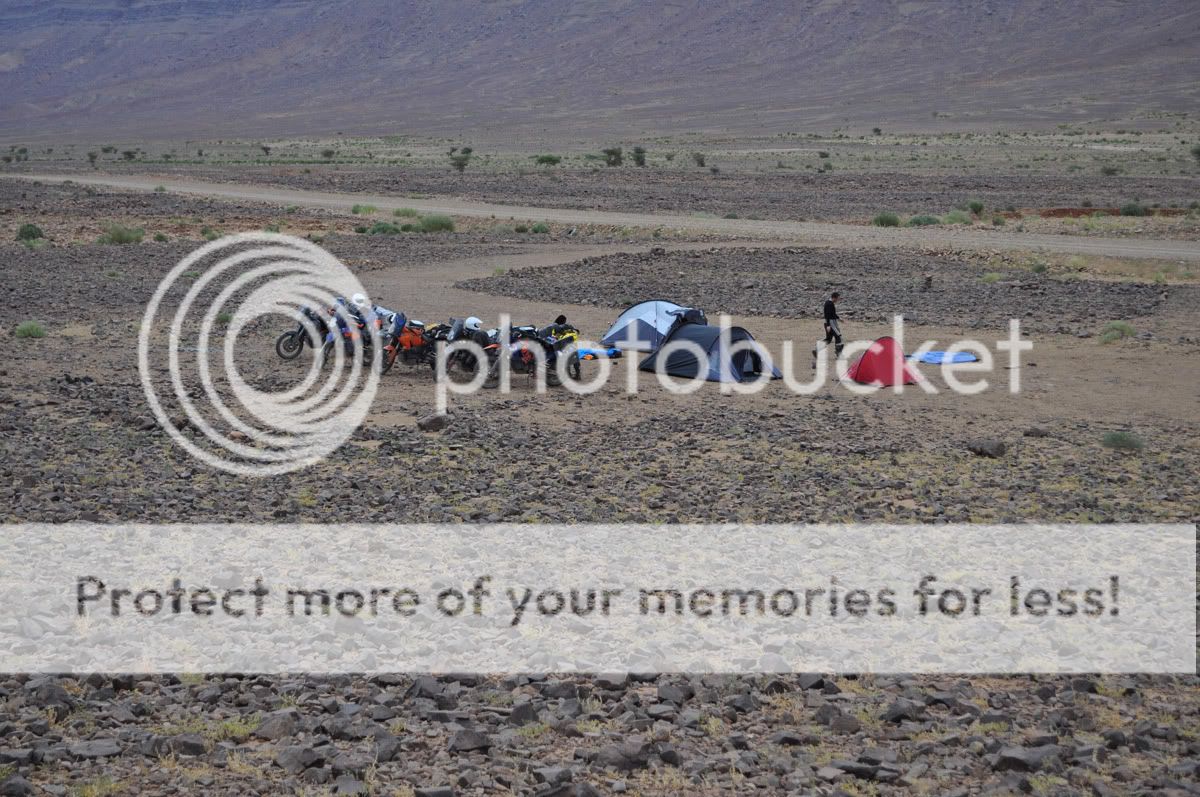
After a few more kilometres we found what looked to be a reasonably rock-free, flat area to pitch our tents in. As anyone who camps will tell you, no matter how careful you are, you will always end up pitching on something that you’ll only discover once you’re in bed and lying on it – and inevitably in such a rocky location it proved to be so.

A friend had kindly lent me his lightweight tent for the trip, and with hindsight I probably ought to have tried erecting it at home rather than trying to do it for the first time when it really mattered. The other four got their tents up while I struggled with mine – the strong wind and light structure of the tent made it resemble a kite more than a tent as I tried to get it to stay on the ground long enough to peg it down.

Photo by Mark Littlewood

Dinner was taken from the long-life food that we’d brought with us for camping / emergency use, and because it’s easy to prepare being boil-in-the-bag: Mine was pasta and meatballs in tomato sauce.

Photo by Mark Littlewood

We waited in expectation as night fell for the stars to come out… only to have full cloud-cover. We saw nothing.

A side-effect of the cloud cover was that the temperature didn’t fall as we had been told it would, so it was a very warm and sticky night. Even the wind was hot. I turned in fairly early hoping to get a good night’s sleep, but it wasn’t to be and I got very little sleep. The mesh walls of my tent weren’t all that good at keeping the desert out of the tent, and as the night went on a layer of sandy grit covered everything in the tent.

Dawn broke, and we were greeted with a spectacular view of the early morning sun lighting up the desert is a wonderful golden glow:


Breakfast was another long-life meal, baked beans with sausages for me, and I realised that I’d forgotten to bring any coffee with me which didn’t help matters (I don’t wake up until I’ve had at least one cup of coffee!). After breakfast it was time to strike camp and carry on towards Zagora.

It’s a funny thing, but you know that there’s nothing in the desert, that’s why it’s a desert, but when you get there and find that there really is nothing there, it still comes as a surprise. But strangely, even there, we weren’t alone.

To be continued…

04 June 2010

The Big Adventure - Part 6

On the seventh day we rested. A leisurely start to the day with a traditional Moroccan breakfast: bread, cheese, coffee and sweet tea, yoghurt and fruit preceded a bike-fettling session before going in to Ouarzazate town centre for lunch.

One of the features of Bikershome is a fully equipped garage that visitors are welcome to use should anything need attention The bikes had stood up well (mechanically) to the abuse of the first few days, with just a check-over, chain adjustment and oil top-up required. We also took the opportunity to effect some repairs to the damage inflicted by rocks. Pete showed Jason how to tidy up the scratches in his fairing, and with some super-glue his Lexan headlight guard was back in one almost complete piece. He also repaired and re-wired the damaged indicator leaving just one missing piece of lens.


Deciding to take some interest in the outside world, we used Pete’s computer to get on the Internet and learned for the first time about the volcanic ash disruption – sparking ideas about riding all the way back to the UK through Europe as an alternative to flying home from Spain.

Another guest staying there was Tim Cullis, who some might know from the UK GSer forum. Tim is a regular visitor to Morocco, and much of the mapping we were using on our GPS receivers was his work. He was able to regale us with stories from adventures past, as well as suggesting possible routes we could take later in the trip. As proof of the vagaries of the Moroccan road (and piste) network he related how one year a route on a fully laden GS took two hours, whereas the following year the same route on an unladen bike took eight.

When you’re out in the mountains you need to be aware that most people you meet won’t know what the trail conditions ahead are like. After being assured that the piste was open and passable, Tim discovered that it had been washed away down the mountain and instead of being open and passable it now no longer existed.

At lunchtime Pete drove us in to Ouarzazate in his pick-up truck. There are only three passenger seats, so the rest of us climbed in the back in typical African style. We went to café favoured by both Pete and Tim, where the speciality of the house was fruit “milkshakes”, although they were more akin to smoothies as there wasn’t any milk in them. Pick a fruit, any fruit: avocado, mango, strawberry, pineapple… and it arrived beautifully blended with fresh fruit juices in to a not too sweet, refreshing drink. From the menu we ordered a “homburger” each, which was unformed minced meat, chopped olives and tomato salsa with seasoning in a hamburger bun-sized, round loaf of bread. To finish we had a mille-feuille pastry, which varies from the French version in that it doesn’t have crème pâtissière between the layers of pastry, but something more akin to vanilla buttercream – and it’s not as tall either – but a bargain at just 2d each, and the local equivalent of a latté coffee: a nous-nous.

Tim had broken the number plate on his bike and needed to get a replacement for his journey back in to Europe, and with this being Morocco nothing’s impossible. Although what he came back with was so amateurish it was almost comical. Motorbikes don’t have registration numbers out there, and the ones for other vehicles are entirely numerical, which isn’t all that helpful for a British registration which is mostly alphabetic. My guess at the reason for the numerical only plates is that this means there isn’t a conflict between arabic and roman scripts as “the west” uses arabic numbers anyway. The addition of a Moroccan flag sticker, similar in style to the blue Euro flag on European plates, completed it.

Back at Bikershome we enjoyed the sunshine on their rooftop terrace, carried on with the bike fettling and made plans for the following day.

Photo by Mark Littlewood

We decided that a circular ride would be a good idea, meaning that for once we could leave our luggage behind. Tim was our route consultant, and with his help we put together a route.

On the edge of Ouarzazate lies the film set for Kingdom of Heaven, which you can go and wander around the outside of. None of us had seen the film (in fact I’ve not found anyone who has seen it) but it certainly made an interesting diversion.


From there, there wasn’t a track to the next main piste, so the instruction was “go north”. The area around the film set was stony with dune-like mounds. Some parts had a very loose surface, and Mark H discovered that too much throttle could instil a sinking feeling.


I also came unstuck when I took a route slightly lower down one of the dunes. Looking ahead I saw that it curved up on to the same plateau, but what I’d missed was a square-cut channel between me and the plateau and as I rode in to it I fell off. The bike is well protected with engine bars and the luggage rack, but of course I missed both of them and put some scratches in fairing around the seat.

We’d had a slight navigation error which had seen us go east rather than north, but we found the main trail easily enough. It was wide, flat and straight, and perfect for a play.


Photo by Mark Littlewood

Gareth in particular managed a good impression of Terminator on his black 950. The pictures here tell the best story – the well defined track carried on and on across the flat landscape until we came to a series of dried-up riverbeds which we had to ride across:


When we got in to the more hilly terrain we found another film set lurking:


Being at the back of the ride I took the opportunity to take some photos to give a sense of the scale:


One of the more curious sights we encountered was the way the telegraph poles were being held up: by the cable. The rocky and, in places, unstable ground obviously isn’t ideal for keeping the poles up.

At the top of the hill we joined the main road leading back down, which was in the process of the being resurfaced. They’d sprayed it with water to keep the dust down, but this left a very slippery yet sticky clay-like surface that kept us entertained until we got to the bit that hadn’t been watered. We also had to stay alert to the random appearance of heavy plant repairing and re-shaping the rock-face.

We stopped for a late lunch at a touristy place which had a row of tables under an open-sided Hessian tent. The tables and chairs were very low, and those that sat with their backs to the Hessian discovered it was really quite scratchy as it blew against them. I’m not sure whether we ordered or whether it just arrived, but lunch was a vegetable tagine (mostly carrot) followed by cinnamon orange slices and tea.

Photo by Mark Littlewood

Most of the other customers had already moved on, and we were the only ones left. One of the locals came over to talk to us because he wanted to improve his English. He also owned (or a relative owned, I’m not sure) a shop across the road, and on seeing Mark L’s watch he wanted to swap a carpet for it. Needless to say Mark declined – not least because we’d no way of getting a carpet home again.

Where places have a car park, you’re expected to pay a few Dirham to use it. Being the stingy people we are, we’d parked on the other side of the road for free. Although an out of control sounding articulated lorry thundering down the hill caused some concern – if it had hit the bikes they’d have gone over the edge of the cliff. I’m sure it sounded worse than it actually was – when they’re empty they rattle a lot, and on the gravelly road the wheels will be prone to locking up anyway.

It wasn’t far to the main road which would take us back to Ouarzazate, along a two-lane road with only one lane’s worth of tarmac. Not that there was much traffic, and on the Adventure taking to the gravel verges wasn’t really a problem. What was becoming a problem was Gareth’s bike.

It had become more and more rattley as the day had gone on, and the oil light had been flickering at idle. On the ride back to Bikershome it came on properly, and the rattle was really sounding unpleasant. What was it? There was plenty of oil on the dipstick – oil pump? Camchain tensioner?

Back at base we got on the Internet to harness the power of the combined knowledge of various forums – although being a Saturday night would most of them be in the pub? Or just back from the pub?

The first few replies gave a consistent diagnosis: water pump. It’s a known weakness, and we had brought seal kit with us so it was just as case of getting in there to confirm it, and then repair it. So that was another day at Bikershome.

Next morning we set to work. First job was to confirm the diagnosis by checking the condition of the oil filter. Using some old tyres as a cushion we laid the bike on its side and pulled out the filter – eureka! It was crinkled, which is a sure sign of water in the oil and a good indication that the oil pump seals have had it. We set to work undressing the bike and removing the clutch cover to get at the oil pump. The inside of the clutch cover had the classic ‘mayonnaise’ blend of oil and coolant.


In the midst of this excitement, Pete had been called away to help rescue a couple of bikes: a FJR and a Bandit. The Bandit was quite severely damaged after being run off the road by a taxi, and somersaulting in to a concrete drainage channel. The owner, also called Pete, had gotten away relatively lightly with just a dislocated elbow – and a big repair bill.

Mark H decided to set off to explore some waterfalls that he thought weren’t too far away. After he’d gone, we got the map out and found that they were about a four hour ride away… No, he didn’t get to them.

To help get the new bearings in to the water-pump casing the instructions suggest putting the casing in the oven for a few minutes. The resulting smoke was eye-watering, and didn’t go down all that well with our hosts, but it worked and by tea time Gareth’s bike was back together. We didn’t have a new oil filter with us, but fortunately Pete has a KTM Super Enduro which has the same engine, and he had a spare filter. Job done.


For dinner that night Pete and Zineb took us in to Ouarzazate to eat because Zineb had got something in her eye earlier in the day (we don’t think it was related to the engine casing in the oven though).

While we were out Pete got a call from a group of Polish riders on Honda Africa Twins who’d arrived and were needing assistance. They’d been out in the desert, two of their bikes had broken down, and they’d been charged 500€ each to get the bikes rescued. Ouch! They stayed the night at Bikershome, most of them sleeping on the sofa-benches because by now all the beds were full. Their plan, incidentally, was to get a trailer made so they could use their support vehicle to tow the bikes back to the border, get them back in to Spain and let their breakdown insurance deal with them.

And so, after fours nights in the Bikershome, we set out for the desert.

The Big Adventure - Part 5

By morning the rain had cleared, and we were horrified to find five cleaner (on one side at least) bikes parked outside. Sure enough, Grandpa was still sitting on the step: although I think I woke him when I went out with my luggage.

After a typical Moroccan breakfast, including coffee with goats’ milk, we set off towards yesterday’s target, the Dades Gorge. This meant riding back through the village, but the touts from the night before were obviously still in bed and we had no trouble at all riding through. The road skirts around the edge of the flood-plain, and after an unusually wet winter the amount of greenery was quite impressive and there was even water in the river.

Arriving in a village on market (souk) day was an interesting experience, and we initially missed the turning to start our journey through the mountains to the top of the gorge. A U-turn, and an opportunistic Dirham-scrounger later, we set off along another riverbed. The road had obviously seen a tough winter, and was in a very poor state of repair. At one point it diverted in to the dry bed of the river itself and the shale made tough going before it rejoined the actual road.

I had my second misjudgement of the trip and clobbered one of my panniers on a rock, dislodging it from the bike. A feat I repeated soon after, on another rock. The only apparent damage was to the lock securing the pannier to the bike which would hold the pannier on the bike but no longer locked with a key. Much later I discovered that I’d put a hole in the pannier, and when trying to fill the water jacket it just poured straight out again.

Climbing up the winding track was a matter of preference and technique. With a steep drop to one side and a rock face on the other you had two choices: the inside or outside wheel-track. Most people opted for the inner track, although I preferred the outer track because the odds of clouting a pannier on a rock were much lower.

Riding along a ledge like that isn’t for the faint-hearted because the potential for things to go wrong is significant. That said, if you concentrate too much on the drop then you have less concentration for the road ahead, and there’s always that age-old hazard of target fixation. I have done a fair amount of riding on tracks like this one and the drop isn’t of particular concern. Obviously I respect it, and know what could happen, but otherwise I treat it much like any other stony track.

The map showed a settlement near the (road’s) summit, but when we got there it turned out to be a single, abandoned house without a roof. The views were spectacular though, and we were close to the snow-line: riding around a bend in to a shaded spot and finding a bank of snow on a warm sunny day comes as something of a surprise.


After a short break we began our slow descent, and it was here the differences between our bikes began to show. My 990 is completely standard in terms of gearing and I was struggling to ride slow enough not to run in to the back of the bike ahead, and even in first gear I was having to slip the clutch. A popular modification is to change the number of teeth on the sprockets to improve off road performance, and this probably helped the others – although I don’t know exactly how their bikes were setup.

Being at the back of the ride I took advantage of being able to stop and take photos of the scenery and the others ahead:


Once we got to the bottom we had a river to cross. Although not our first of the trip, it was the widest, deepest and fastest flowing. A gathering of children raised the stakes even higher in terms of sweets, Dirham and general pestering. Whilst Mark L went to see if there was an easier place to cross, Gareth waded in and the rest of us rode though with little difficulty. Mark returned having found something that looked easier to find us all on the other side, so he had a go himself after entrusting his camera bag to me to carry through on foot.


Anxious to get away from the pestering of the children we set off down the road and found a shaded spot between the river and the cliffs to have a breather. We’d not been there long when two young girls on donkeys came past and Mark H tried to take a photo of them – which didn’t go down well at all: Many people in Morocco, especially those in more isolated or rural locations, are superstitious about having their photo taken and the effect it might have on them in the afterlife. It didn’t stop a degree of banter with them, and I suspect they understood more than they let on.

Having been at the back of the ride most of the day I took the lead for the next bit. Mark L showed me on the map where we were going and told me to look for a right-turn at some point. When we came to a junction with a road to the right I stopped and pointed at it. Looking back I saw Mark apparently nodding his head, so I duly turned right – only to discover that the nod was indicating that we should go straight-on. Oh well…

We knew that the road to the Dades Gorge had been properly surfaced because it is a popular tourist attraction, but we were coming at it from the other side and the road was still piste. There is a village at the top of the gorge, and it’s here that you join the tarmac.

There’s no denying that it’s a spectacular sight, but sadly it is also full of tourists. We stopped to take some photos before carrying on through.


There are a few cafés along the road side, and we decided to stop for a coffee and something to eat. One of the things that we were missing most was junk food like chocolate. The healthy Moroccan diet is all very well, but sometimes you need some tooth-rotting sugary sweetness (other than the tea), and when we saw they had Snickers bars we couldn’t resist.

Looking down from the café gave a superb view of the road ahead: hairpin after hairpin, on recently surfaced tarmac. Brilliant.

Photo by Mark Littlewood
 
A common way for tourists to see Morocco in with a Berber guide in a 4x4, and as we were preparing to leave, a number of these 4x4s drew up outside. We chatted with a Canadian family who appeared to be doing a whirlwind tour of the country, and had our photos taken by group of American tourists who were interested in what we were doing, where we were going, what we were carrying etc.

We set off down the road ahead of the 4x4s and even on a heavily laden, knobbly-tyred KTM it was a fantastic bit of road. While we’d been having coffee we’d seen a group of three cruiser-style bikes go past heading up the gorge, and we half wondered if they’d be heading over the top the way we’d come, or whether they’d be following us down the surfaced road (silly question!).

The road wound its way down the gorge, and offered some spectacular views:


Our plan for the night was to head to Ouarzazate [Wazzat] and stay at the well known Bikershome. This meant a lengthy, and mostly dull, road ride across the plains. The road was busy, and there were a number of convoys of road bikes going the other way. From the plates I think they were mostly German and guessing from guide at the front of each group, an organised tour. There were a good number of BMW GSs amongst them, but one thing we did notice is that despite the number of them we saw, none of them bore any signs of being used on the pistes. It seems a shame to have ridden all that way and not take advantage of exploring the more remote parts.

Heading in to the setting sun wasn’t much fun, and the dust on our visors (inside and out) left us peering through the shadow cast by the peak of the helmet. Another hazard was the presence of so many tourist 4x4s, mostly Land Cruisers, with their kamikaze Berber drivers having no qualms about overtaking in to the face of oncoming traffic, then barging their way back in-between us to get out of the way.

This was the busiest we saw a road outside of a city, and as usual there were regular Police checkpoints and speed-checks. A new bypass around one town, Skoura, caused a bit of confusion with Ouarzazate being signposted the opposite way to the road shown on the map..

On the way through the city centre we needed to stop for cash, but the presence of a cash machine doesn’t guarantee that you’ll be able to get your money! It was the one recurring problem, and one that there isn’t a solution to other than take advantage of any working machine you do find! With the delays and detours it was getting dark by the time we wound our way through centre of Ouarzazate to Bikershome.

Bikershome is run by Dutchman Peter Buitelaar and his lovely Moroccan wife Zineb. Pete was out when we arrived, but Zineb made us very welcome, taking their 4x4 out of the garage to make room for our bikes, and cooking us a very welcome meal.

We intended to stay two nights, to allow us a rest-day, but plans change.