With the recent heavy snow, it wasn't much of a surprise when the Northants 4x4 Response Team was called into action to assist the council and other services. Responders were out continuously through the Saturday night, all day Sunday and in the late evening on Sunday night.
My own call out came on Sunday morning: could I go to Wellingborough to assist with Meals-on-Wheels... and PS, there'll be a BBC cameraman waiting for you.
Arriving at MoW HQ in the Defender, I met up with two other responders, Dave and Mark, and was introduced to the MoW team and the cameraman. The plan was to go out delivering the hot meals in our Land Rovers, escorting the lady who usually does the round, starting in Wellingborough and heading in a circular route out to Woodford and back.
Time is of the essence with MoW as the food needs to arrive hot, and at lunchtime. Unfortunately the needs to filming slows the process down, so the meals were transferred to Dave's vehicle while Mark and I helped the cameraman get the footage he required.
By early afternoon the meals were delivered, the BBC had their footage, and an interview with me, destined for the regional BBC Look East programme that night.
At 18.50 I sat with bated breath wondering exactly what the results of our effort would be:
Not too painful, but do I really sound like that?!?
Next morning, I'm having breakfast when the Breakfast edition of Look East starts and to my surprise I'm on it again, with a different part of the interview and Mark in a supporting role as we point at a map:
A great bit of publicity for the Response Team, which has been picked up by other groups and the national 4x4 Response forum too. It's an honour to be able to represent the Response Team network like that, and to show that we, often criticised, 4x4 drivers aren't all bad.
08 February 2012
25 November 2011
Freelander
I've written pieces on my Discovery and Defender, but have neglected my Freelander.

Quite a few of my 4x4 exploits have been in my Freelander. It's a 2005 Td4 which has been modified with:

People say that Freelanders are not 'proper' Land Rovers and are only suitable for driving to the supermarket: nonsense. I've taken mine around off road courses and shown up a few Defenders by not getting stuck when they've needed a tow...

Quite a few of my 4x4 exploits have been in my Freelander. It's a 2005 Td4 which has been modified with:
- 2" suspension lift for extra ground clearance
- Mantec sump-guard
- DAP Sliderz rock guards
- Reinforced front recovery points, and
- Spare-wheel mounted work light.
People say that Freelanders are not 'proper' Land Rovers and are only suitable for driving to the supermarket: nonsense. I've taken mine around off road courses and shown up a few Defenders by not getting stuck when they've needed a tow...
© Abingdon 4x4 Festival
09 November 2011
Punch Challenges
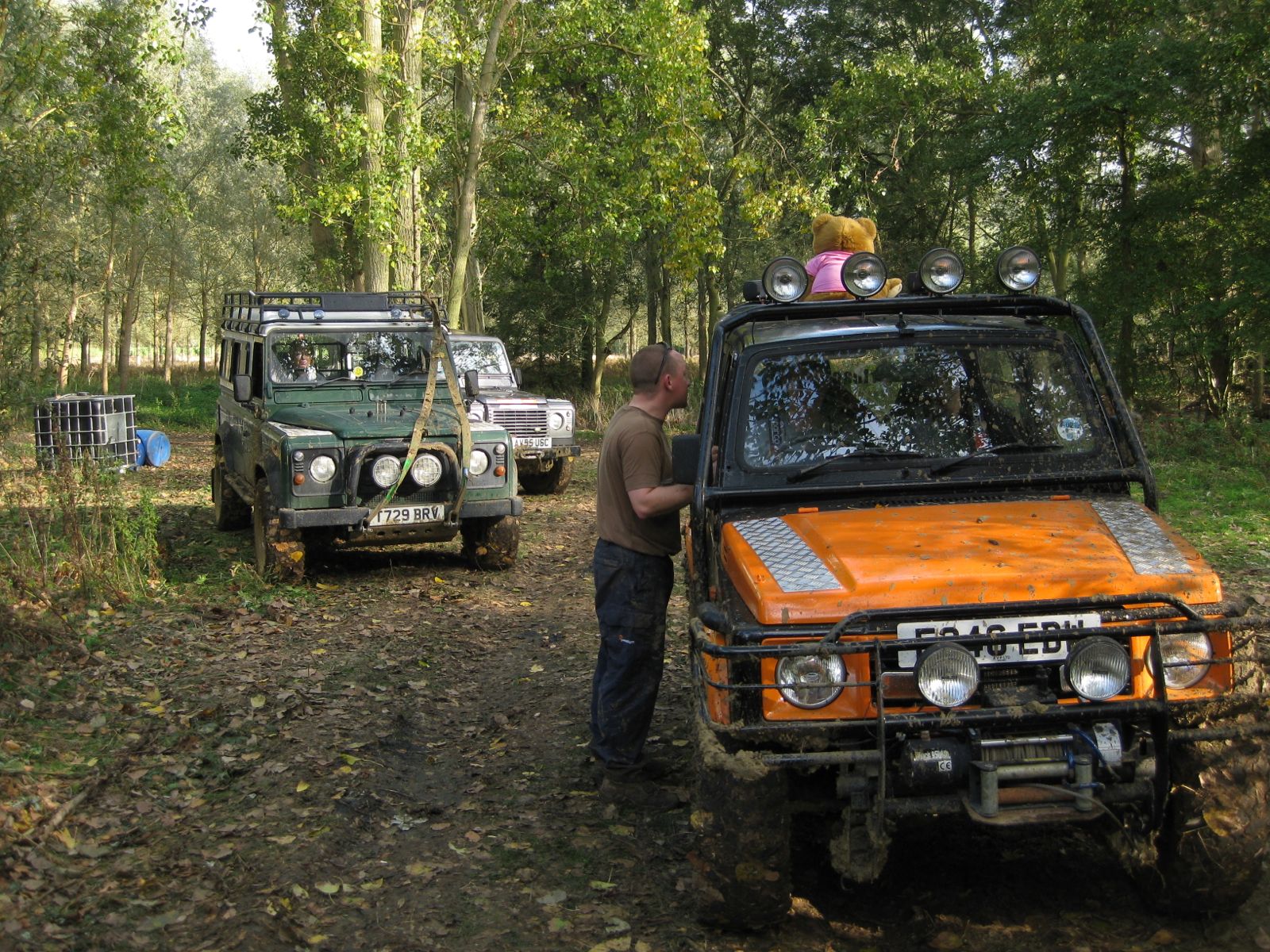
After taking part in a 4x4 trial in the Freelander, I have been trying my hand at another off road competition in the form of Punch Challenges with Northants 4x4.

The concept is very simple: a laminated card is attached to the passenger-side door mirror, a number of orienteering punches are set out around a site and the aim is to visit and stamp your card with as many punches as possible. As the card is attached to the vehicle's mirror, you need to get the card to the punch.
Each punch has a different pattern of pins to mark the card, and the card has numbered boxes corresponding to the numbers on each punch. It is a simple matter then to match them up: e.g. mark box A3 on the card with the punch labelled A3. Simples. The person with the most punches in the shortest time is the winner.
Of course it is the location of the punches plays a big part, and this is where the challenge element comes in. They can be anywhere: up embankments, across streams, in deep water, through narrow gaps in trees, in ditches etc., so the skill of the driver, and the type of vehicle, plays its part too.

A heavily modified 4x4 with larger wheels, a winch, raised air-intake etc. will find it much easier than a completely standard vehicle, so a handicap system is employed. At the start of the challenge, each entrant is told how many punches they need to collect: the more modified the vehicle, the more punches will be required. This allows the unmodified entrants to avoid some of the more extreme punches that they are incapable of getting to.
Whilst it is possible to do it while single-crewed, it is much easier to have a co-driver (AKA "winch-bitch") in the passenger seat to punch the card, look for the punches (which are often hidden), guide you in to tight spaces and, if necessary, help you winch yourself out of trouble.

Depending on the site and how the punches have been laid out, it can take from a couple of hours to most of the day to get them all. Even if you are not especially competitive and are just doing it for fun, the opportunity to get a punch gives a purpose to the day and gives you an incentive to stretch yourself to have a go at things you might not normally consider trying.
The nature of the event means that you will be putting yourself and your vehicle at a degree of risk in terms of damage, but with care and patience it should be possible to emerge unscathed - although most Land Rovers are not watertight, so fording deep water is likely to result in wet feet (don't ask me how I know...!).

Whether you win or not, it's the taking part and having fun that counts!
The concept is very simple: a laminated card is attached to the passenger-side door mirror, a number of orienteering punches are set out around a site and the aim is to visit and stamp your card with as many punches as possible. As the card is attached to the vehicle's mirror, you need to get the card to the punch.
Each punch has a different pattern of pins to mark the card, and the card has numbered boxes corresponding to the numbers on each punch. It is a simple matter then to match them up: e.g. mark box A3 on the card with the punch labelled A3. Simples. The person with the most punches in the shortest time is the winner.
Of course it is the location of the punches plays a big part, and this is where the challenge element comes in. They can be anywhere: up embankments, across streams, in deep water, through narrow gaps in trees, in ditches etc., so the skill of the driver, and the type of vehicle, plays its part too.

A heavily modified 4x4 with larger wheels, a winch, raised air-intake etc. will find it much easier than a completely standard vehicle, so a handicap system is employed. At the start of the challenge, each entrant is told how many punches they need to collect: the more modified the vehicle, the more punches will be required. This allows the unmodified entrants to avoid some of the more extreme punches that they are incapable of getting to.
Whilst it is possible to do it while single-crewed, it is much easier to have a co-driver (AKA "winch-bitch") in the passenger seat to punch the card, look for the punches (which are often hidden), guide you in to tight spaces and, if necessary, help you winch yourself out of trouble.

Depending on the site and how the punches have been laid out, it can take from a couple of hours to most of the day to get them all. Even if you are not especially competitive and are just doing it for fun, the opportunity to get a punch gives a purpose to the day and gives you an incentive to stretch yourself to have a go at things you might not normally consider trying.
The nature of the event means that you will be putting yourself and your vehicle at a degree of risk in terms of damage, but with care and patience it should be possible to emerge unscathed - although most Land Rovers are not watertight, so fording deep water is likely to result in wet feet (don't ask me how I know...!).

Whether you win or not, it's the taking part and having fun that counts!
14 September 2011
Test Drive: Freelander 2


From the outside, the resemblance between the two cars is very obvious: the profile, and in particular rear windows being very similar in shape. The 2 is taller than the original, although mine has been lifted by 2" so these two are same height.


There are a number of automatic systems in the car:
- Headlights
- Windscreen wipers
- Dipping rear-view mirror
- Central locking
- Stop-Start
The automatic headlights don't work all that well with them turning on and off, seemingly at random, on an overcast but not particularly dull day in Peterborough. Why do we need automatic headlights? I can tell when it gets dark.
With the automatic windscreen wipers, there are three settings on the wiper stalk: automatic, on and fast. There's no intermittent setting, which I presume it replaced by the automatic setting. I have a distrust of automatic systems which stems from my experiences in a Peugeot 206 several years ago, where the automatic windscreen wipers decided to work only in the dry, and when passing a lorry that was throwing up bucket-loads of spray, they decided that wipers were not necessary - which lead to an exciting few moments as I tried to override the automatic system so I could see where I was going.
My concerns were not entirely unfounded, with erratic wipes of the screen in completely dry weather. Automatic wipers seem very like a solution to a problem that doesn't exist: As with the headlights, I can tell very easily when I need my wipers on.

In what I assume is a attempt at emission reduction, the 2 has an automatic stop-start system: come to a halt, put the gear lever in to neutral, lift the clutch and the engine stops. A green 'Eco' light lights up on the dashboard to let you know it's stopped. When you're ready to go, push down the clutch and before your foot reaches the floor, the engine's running again and off you go. While stopped, all the other systems in the car keep running. If you stop for too long, the engine will start again of its own accord; presumably to prevent the various systems running down the battery. The stop-start system can be turned off by a button on the centre console, but it will be reactivated again next time you start the car.
At Motorway speeds, the cabin remains quiet with little engine, wind or tyre noise. Steering is light and responsive, possibly a little too light and responsive for a vehicle of that size - a little more weight would stop the steering being quite so flighty at speed, especially on faster turns such as open roundabouts or on fast, twisty cross-country roads.
The radio has a CD player as well as an Aux socket to plug in your iPod, and the speakers give a good performance. There's even a sub-woofer hidden somewhere in the car - which was turned up to the max when I picked up the car, which made Radio 2 sound a little odd. There's also a built-in Bluetooth hands-free mobile phone system, which works very well and accounts for many of the buttons on the centre console.

A large touch-screen at the top of the dashboard contains the built-in satellite navigation system. The user interface is not particularly user-friendly, and it took a lot of fumbling around and back-tracking before realising that the "Destination" label at the bottom of the screen was actually a button. On the road, the announcements are clear and easy to hear over the car's speakers, but the timing of the announcements is very poor. Approaching a turn, your first warning is at just 400 yards: if you're not in the inside lane at the time, forget it - you're going to miss your turn. Bizarrely, on Motorways (and only on Motorways, not dual carriageways) it extends the warning to one mile.
The second announcement is at 200 yards, almost before the first announcement has finished. The map set on board has similar errors to other navigation systems, leading to vague and confusing instructions; especially in towns where there are lots of junctions and roads in a small area where it strings instructions together for multiple turns.
Yes, you can look at the screen, but the maps are very diagrammatic and don't reflect the actual arrangement on the road. Also the location and dimness of the screen means you cannot easily see what it's showing. As a very expensive (£1530) option on the Freelander 2, it's a big disappointment and I certainly wouldn't be choosing it over my my much cheaper, more accurate and clearer Garmin.

There is a trend in some cars for soft-touch indicators that don't stay tipped in the appropriate direction, like the aforementioned BMW. The stalks in the 2 behave as indicators should, staying cocked until cancelled either automatically by turning the wheel, or moving the lever back by hand.
At the back of the car, the 2 has a lift-up boot instead of the side-opening one on the original. It's a big, fairly heavy door, held up on gas rams. A shorter person might struggle getting it closed as it's a bit of reach up when fully open. The boot space is much greater than on the original, although the floor starts much higher up to allow space for the spare wheel. Which isn't there.


Would I buy one? Maybe. There are too many automatic systems on it for my taste that cannot be turned off or easily worked around (why would you want the the doors to lock automatically? In an accident, I want people to be able to get me out!). On the other hand it drives very nicely, is quiet, comfortable and while I've had it the average fuel consumption has been around 36mpg. It just needs to feel a bit chunkier and more like a Land Rover.
With thanks to Hammond Land Rover, Halesworth, Suffolk, for lending me the Freelander 2 while repairing my Defender.
22 August 2011
Irish Weekend - May 2011
After my Irish trip in February, I vowed it wouldn't be fourteen years before I went back again. When some of the KTM Forum guys in Northern Ireland posted that they were heading to Co Dongal for the long weekend I jumped at the chance of joining them.
My plan was simple: ride to Birkenhead, take the overnight boat to Belfast, meet with Kyle (the ringleader) for breakfast, ride, camp overnight, ride, and get the overnight boat back again.
Stena Line ISF operate the ferry service, and the overnight boat leaves at 22.30 and gets in at the early hour of 06.30. Boarding commences well in advance of departure, so although I arrived at 19.30 I was in the Mersey Seaways's snack bar soon after with a group of three other motorcyclists from Norfolk on their way to the Antrim coast.
The boat is best described as basic, although the cabins were clean and comfortable, the food was pretty poor, and they ran out of glasses in the bar...

An 06.30 arrival means getting up about 05.30 (they kick you out of the cabins at 06.00), but I didn't quite get around to breakfast on the boat. Fortunately it was only a half-hour ride to Kyle's house for an
Ulster fry :)

From there we headed over to the Donegal coast, picking up another two others along the way. The sun was out, the roads were clear, and it was a wonderful run through the spectacular scenery.

We were camping at the Sleepy Hollow camp site, which was very aptly named, and they'd kept plenty of space for us, including reserved parking for the bikes. After pitching our tents, I unexpectedly tested
mine... Well, it had been an early start and a poor night's sleep...

Time for an afternoon ride. There are a lot of gravel tracks in the area, so instead of the area we were expecting to ride (a half-hour ride away) we explored the new tracks while trying not to get stuck in the peat bogs!
Somehow one of our group managed to get lost, as did the person sent to find him. Just when we though we'd found the local equivalent of the Bermuda Triangle, we were reunited up a side-trail. Quite how the wrong turning had been made is a mystery.

Unfortunately some of the longer trails through woodland were closed for forestry operations, but they'll be there for next time.
On one section of trail through an area there they'd been cutting peat, I beached the bike on top of a mound - that takes some doing with the 990, and a bit of a shove to get it off again (and all on video!).
With Saturday's plan taking shape, we headed back to camp for a cuppa in the evening sun before retiring to a local pub for a superb steak and plenty of local ale (not Guinness - I don't like it).
Saturday morning, and a trip to a local petrol station cafe for a decent cooked breakfast. The other riders joining us spotted our bikes as they rode past, so came and joined us. Everyone was on a KTM 9x0 Adventure, except one brave chap on a Suzuki V-Strom 650.

Knowing the trails a bit better than yesterday, we strung them together more smoothly, found a few more, and generally enjoyed ourselves.
One of the hills was home to a wind farm (isn't there enough wind already without farming more?) and the view was amazing. The track up to it was a mix of steep bits, not-so-steep bits, some gravelled, some sealed - I almost threw myself over the bars on the way up when I found a larger rock in the road (the only one for miles).

Lunchtime approached so we headed in to a village for lunch, and found the Seaview Hotel a short distance inland. Toasties were the order of the day, and the landlord was able to suggest some trails we could try - even taking Kyle in his car to show him where they were. Sadly they were the closed forestry ones. Undeterred, he called another chap who's a rally driver and knows the area well, and he came over to the hotel to talk to us about the trails too - that doesn't happen over here!
We were getting back on the bikes when someone noticed that my front tyre looked a bit soft. Flat, in fact. Fortunately I'd stuck a front tube in my luggage just as I was leaving home, so it wasn't long before we'd changed the tube and found a four-inch thorn stuck in the tyre. Impressive!

The others had gone for a ride while we changed the tube, so from there we decided to return to the camp-site. I was booking on the overnight ferry at 22.30 from Belfast, so after striking the tent I set off in hot persuit of the chap on the V-Strom. It was a very brisk run through the mountains, joining the main roads in Northern Ireland and I got to the ferry terminal just after 20.00.
Once on the boat, the Lagan Seaways, I found myself in the queue for cabins behind Guy Martin - the TT rider and star of the BBC series "The Boat That Guy Built" - who'd misplaced his boarding card. He headed off to the restaurant while I made do with the snack bar again (the food was better, but still not brilliant).
As it was Mum's birthday I went on deck to give her a call to the accompaniment of Celine Dion's greatest hits on the PA system: hearing the theme from "Titanic" whilst on a ferry is... well, not ideal if you're a nervous passenger (which I'm not). Although looking at it another way, we were just a few hundred yards from the place RMS Titanic was built.
The crossing home was uneventful, if slightly rougher that the outward journey, and I didn't see Guy in the morning - perhaps he jumped off as we passed the Isle of Man?
Arriving early at Birkenhead, it was 06.30 as I left the port for the ride home. I was the only bike on board, and it had been well secured with three wheel-chocks and two straps. I guess they don't see bikes all that often!

Some excitement on the ride down was finding the load-liner of a pick-up between lanes 2/3 on the M6. I thought a call to the Highways Agency was in order at the next emergency phone - and before I hung-up I could see an incident unit on the scene. Glad it wasn't dark and wet or it could have been nasty, although the traffic was very light.
A brilliant weekend, well worth all the travelling.
My plan was simple: ride to Birkenhead, take the overnight boat to Belfast, meet with Kyle (the ringleader) for breakfast, ride, camp overnight, ride, and get the overnight boat back again.
Stena Line ISF operate the ferry service, and the overnight boat leaves at 22.30 and gets in at the early hour of 06.30. Boarding commences well in advance of departure, so although I arrived at 19.30 I was in the Mersey Seaways's snack bar soon after with a group of three other motorcyclists from Norfolk on their way to the Antrim coast.
The boat is best described as basic, although the cabins were clean and comfortable, the food was pretty poor, and they ran out of glasses in the bar...
An 06.30 arrival means getting up about 05.30 (they kick you out of the cabins at 06.00), but I didn't quite get around to breakfast on the boat. Fortunately it was only a half-hour ride to Kyle's house for an
Ulster fry :)
From there we headed over to the Donegal coast, picking up another two others along the way. The sun was out, the roads were clear, and it was a wonderful run through the spectacular scenery.
Photo by Terry Irvine
We were camping at the Sleepy Hollow camp site, which was very aptly named, and they'd kept plenty of space for us, including reserved parking for the bikes. After pitching our tents, I unexpectedly tested
mine... Well, it had been an early start and a poor night's sleep...
Photo by Eugene Gillen
Time for an afternoon ride. There are a lot of gravel tracks in the area, so instead of the area we were expecting to ride (a half-hour ride away) we explored the new tracks while trying not to get stuck in the peat bogs!
Somehow one of our group managed to get lost, as did the person sent to find him. Just when we though we'd found the local equivalent of the Bermuda Triangle, we were reunited up a side-trail. Quite how the wrong turning had been made is a mystery.
Unfortunately some of the longer trails through woodland were closed for forestry operations, but they'll be there for next time.
On one section of trail through an area there they'd been cutting peat, I beached the bike on top of a mound - that takes some doing with the 990, and a bit of a shove to get it off again (and all on video!).
With Saturday's plan taking shape, we headed back to camp for a cuppa in the evening sun before retiring to a local pub for a superb steak and plenty of local ale (not Guinness - I don't like it).
Saturday morning, and a trip to a local petrol station cafe for a decent cooked breakfast. The other riders joining us spotted our bikes as they rode past, so came and joined us. Everyone was on a KTM 9x0 Adventure, except one brave chap on a Suzuki V-Strom 650.
Photo by Terry Irvine
One of the hills was home to a wind farm (isn't there enough wind already without farming more?) and the view was amazing. The track up to it was a mix of steep bits, not-so-steep bits, some gravelled, some sealed - I almost threw myself over the bars on the way up when I found a larger rock in the road (the only one for miles).
Lunchtime approached so we headed in to a village for lunch, and found the Seaview Hotel a short distance inland. Toasties were the order of the day, and the landlord was able to suggest some trails we could try - even taking Kyle in his car to show him where they were. Sadly they were the closed forestry ones. Undeterred, he called another chap who's a rally driver and knows the area well, and he came over to the hotel to talk to us about the trails too - that doesn't happen over here!
We were getting back on the bikes when someone noticed that my front tyre looked a bit soft. Flat, in fact. Fortunately I'd stuck a front tube in my luggage just as I was leaving home, so it wasn't long before we'd changed the tube and found a four-inch thorn stuck in the tyre. Impressive!
The others had gone for a ride while we changed the tube, so from there we decided to return to the camp-site. I was booking on the overnight ferry at 22.30 from Belfast, so after striking the tent I set off in hot persuit of the chap on the V-Strom. It was a very brisk run through the mountains, joining the main roads in Northern Ireland and I got to the ferry terminal just after 20.00.
Once on the boat, the Lagan Seaways, I found myself in the queue for cabins behind Guy Martin - the TT rider and star of the BBC series "The Boat That Guy Built" - who'd misplaced his boarding card. He headed off to the restaurant while I made do with the snack bar again (the food was better, but still not brilliant).
As it was Mum's birthday I went on deck to give her a call to the accompaniment of Celine Dion's greatest hits on the PA system: hearing the theme from "Titanic" whilst on a ferry is... well, not ideal if you're a nervous passenger (which I'm not). Although looking at it another way, we were just a few hundred yards from the place RMS Titanic was built.
The crossing home was uneventful, if slightly rougher that the outward journey, and I didn't see Guy in the morning - perhaps he jumped off as we passed the Isle of Man?
Arriving early at Birkenhead, it was 06.30 as I left the port for the ride home. I was the only bike on board, and it had been well secured with three wheel-chocks and two straps. I guess they don't see bikes all that often!
Some excitement on the ride down was finding the load-liner of a pick-up between lanes 2/3 on the M6. I thought a call to the Highways Agency was in order at the next emergency phone - and before I hung-up I could see an incident unit on the scene. Glad it wasn't dark and wet or it could have been nasty, although the traffic was very light.
A brilliant weekend, well worth all the travelling.
Some footage from my helmet camera.
Self-Service Checkouts
I know this 'blog is supposed to be about my travels, but while on those travels I've had a few problems with self-service checkouts in a variety of shops. The problems range from forgetfulness on my part right through to... well... stupidity.
On a recent trip to a well known furniture shop of a Swedish persuasion, I bought a large recycling 'bucket' with handles. I used the bucket to put my other purchases in before going to the checkout. They don't have scales on their self-service ones, so I very carefully took everything out of the bucket, scanned everything, checked it twice on the screen, moved the bucket to the other side of the till and put everything back in it.
I was halfway to the door when the penny dropped... Once I got to the door (I was on an escalator at the time) I went back and confessed that I hadn't remembered to scan and pay for for the bucket itself. Firstly I was directed to customer returns, but they can't take money, only refund it. Eventually I was ushered to the front of the checkout queue where I was thanked for my honesty and everything was sorted out. My conscience wouldn't have let me not pay for it, so there was no question of not paying for it and I was very embarrassed at making such a stupid mistake.
A few days later, I stopped a northern supermarket for my weekly shop. After dealing with the somewhat temperamental and irritable self-service machine, I took my shopping and receipt and drove home. The following day, when I went to pay for something in another shop, I realised that I'd left my credit card in the till's chip and PIN machine - a call to the shop confirmed it and, as I'd already spoken to the card company, I asked that they destroy it.
But my crowing achievement took place some months ago, in another supermarket (one that's expanded all over the world), where after paying for my shopping, collecting my receipt and card, I then left the shop leaving my shopping neatly bagged at the checkout...
I'm sure I'm not the first to have done any of these, and I dare say I won't be the last. Perhaps checking-out shopping is best left to the experts.
On a recent trip to a well known furniture shop of a Swedish persuasion, I bought a large recycling 'bucket' with handles. I used the bucket to put my other purchases in before going to the checkout. They don't have scales on their self-service ones, so I very carefully took everything out of the bucket, scanned everything, checked it twice on the screen, moved the bucket to the other side of the till and put everything back in it.
I was halfway to the door when the penny dropped... Once I got to the door (I was on an escalator at the time) I went back and confessed that I hadn't remembered to scan and pay for for the bucket itself. Firstly I was directed to customer returns, but they can't take money, only refund it. Eventually I was ushered to the front of the checkout queue where I was thanked for my honesty and everything was sorted out. My conscience wouldn't have let me not pay for it, so there was no question of not paying for it and I was very embarrassed at making such a stupid mistake.
A few days later, I stopped a northern supermarket for my weekly shop. After dealing with the somewhat temperamental and irritable self-service machine, I took my shopping and receipt and drove home. The following day, when I went to pay for something in another shop, I realised that I'd left my credit card in the till's chip and PIN machine - a call to the shop confirmed it and, as I'd already spoken to the card company, I asked that they destroy it.
But my crowing achievement took place some months ago, in another supermarket (one that's expanded all over the world), where after paying for my shopping, collecting my receipt and card, I then left the shop leaving my shopping neatly bagged at the checkout...
I'm sure I'm not the first to have done any of these, and I dare say I won't be the last. Perhaps checking-out shopping is best left to the experts.
Out with the old, in with the new(er).
The Discovery didn't stay long. I've always wanted a Defender, which to me is the definitive Land Rover, and when I bought the Disco I knew I'd probably regret it. So when I found a Defender at an attractive price, in good condition and the type I wanted, a 110 double-cab, it was the end of the Disco.

It's a 110 Double-Cab Td5 XS, first registered in October 2005, with 70k miles on the clock. It's been owned by a farm in Suffolk and has obviously been earning its keep with a few bumps and scrapes - but it's a Defender and they look better that way. The XS spec. means that it has a heated windscreen and seats (which are part leather) and it also has air conditioning.
At the moment it is completely standard, but that will change: the spare wheel lives in the load-bed and takes up a lot of room, so a carrier for the rear will take care of that. It's also lost its 'tent' that it originally left the factory with somewhere along the line, so a new cover will be needed too. And I'm going to keep the winch from the Discovery to fit, so a new bumper and other bits will be needed for that.
And don't worry about the Disco: it's gone to a good home.


It's a 110 Double-Cab Td5 XS, first registered in October 2005, with 70k miles on the clock. It's been owned by a farm in Suffolk and has obviously been earning its keep with a few bumps and scrapes - but it's a Defender and they look better that way. The XS spec. means that it has a heated windscreen and seats (which are part leather) and it also has air conditioning.
At the moment it is completely standard, but that will change: the spare wheel lives in the load-bed and takes up a lot of room, so a carrier for the rear will take care of that. It's also lost its 'tent' that it originally left the factory with somewhere along the line, so a new cover will be needed too. And I'm going to keep the winch from the Discovery to fit, so a new bumper and other bits will be needed for that.
And don't worry about the Disco: it's gone to a good home.
Subscribe to:
Comments (Atom)